Jun 26, 2026News & Insights
Why Lyophilized Peptides Need to Be Reconstituted?
why lyophilized peptides need to be reconstituted?
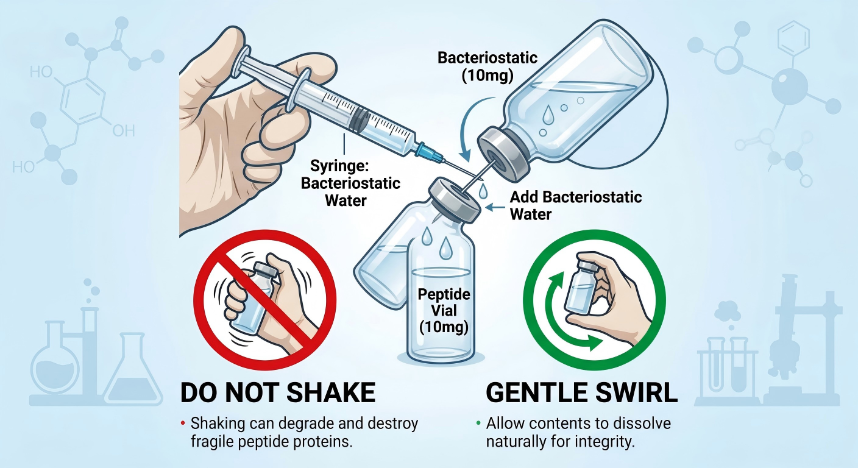
What is Reconstitution?
Reconstitution is the process of adding a liquid solvent (diluent) back into the lyophilized powder to turn it into a usable solution. Since most research—whether in vitro(cell studies) or in vivo—requires the peptide to be in a liquid state for precise dosing and biological activity, this step is essential.
Precision is key: Always use the correct diluent and handle with care.
Why Do They Need to Be Reconstituted?
You might wonder, "Why not just ship them as a liquid?"
- Biological Activity: Peptides are only biologically active when dissolved. In powder form, the molecules are "dormant." Reconstitution "wakes them up" for your experiment.
- Precise Dosing: It is nearly impossible to accurately measure 1mg of powder for a single application. By dissolving 5mg of peptide into 5ml of solvent, you create a 1mg/ml concentration, allowing for highly accurate micro-dosing.
- Bioavailability: Cells and tissues can only absorb and interact with peptides when they are in a physiological solution.
Pro-Tips for Successful Reconstitution
To get the best results from your Sgreats Peptides, follow these golden rules:
- Choose the Right Solvent: Most peptides dissolve in Bacteriostatic Wateror Sterile Saline. However, some very hydrophobic (water-fearing) peptides may require a drop of acetic acid or DMSO. (Check your COA for solubility guidelines!)
- Temperature Match: Let the vial reach room temperature before adding the solvent to avoid "thermal shock" to the peptide. The Gentle Touch:Never shake the vial.Shaking creates bubbles and denatures (breaks) the fragile peptide chains. Instead, gently swirl the vial until the solution is clear.
- Aliquot Immediately: Once reconstituted, peptides start their "countdown." Divide the solution into single-use portions (aliquots) and freeze them to avoid damaging freeze-thaw cycles.