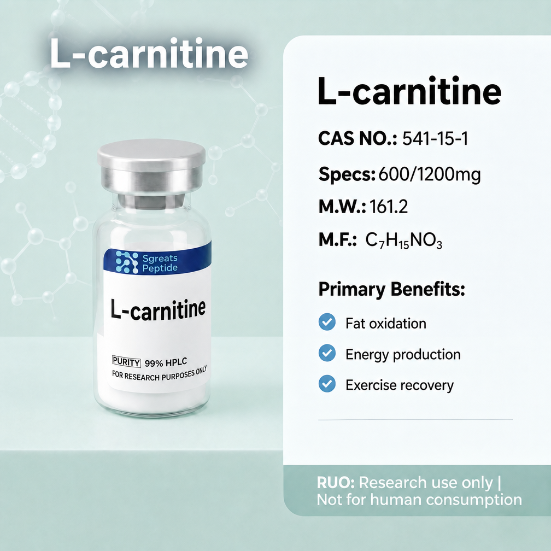



Research Peptide Vials
L-carnitine
L-Carnitine is a quaternary ammonium compound biosynthesized from lysine and methionine. It plays an essential role in the transport of long-chain fatty acids into mitochondria for β-oxidation, and is researched for its metabolic and neuroprotective properties.
Product Name: | L-carnitine |
Synonyms: | CARNITINE, L-;CARNIFEED(R);CARNIKING(R);CAR-OH;ME3-GAMMA-ABU(BETA-HYDROXY)-OH;(R)-BETA-HYDROXY-GAMMA-(TRIMETHYLAMMONIO)BUTYRATE;(R)-3-HYDROXY-4-(TRIMETHYLAMMONIO)BUTYRATE;L-Carnitine Tartrate,L-carnitine,Vitamin BT,L-ca greatrnitine,L-ctheirrnitine |
CAS: | 541-15-1 |
MF: | C7H15NO3 |
MW: | 161.2 |
EINECS: | 208-768-0 |
Product Categories: | Research Peptide |
L-carnitine, also known as L-carnitine and vitamin BT, the chemical formula is C7H15NO3, the chemical name is (R)-3-carboxyl-2-hydroxy-n, N, n-trimethylammonium propionate hydroxide internal salt, and the representative drug is L-carnitine. It is a kind of amino acid that promotes the conversion of fat into energy. The pure product is white crystal or white transparent fine powder. It is very soluble in water, ethanol and methanol, slightly soluble in acetone, and insoluble in ether, benzene, chloroform and ethyl acetate. L-carnitine is easy to absorb moisture, has good water solubility and water absorption, and can withstand high temperatures above 200 ℃. It has no toxic and side effects on human body. Red meat is the main source of L-carnitine, which can also be synthesized by human body to meet physiological needs. It is not a real vitamin, but a substance similar to vitamins. It has many physiological functions such as fat oxidative decomposition, weight loss and anti fatigue. As a food additive, it is widely used in infant food, weight loss food, athlete food, nutritional supplements for the middle-aged and elderly, nutritional fortifiers for vegetarians and animal feed additives.